The Birth Of Pinball : 1800s - 1900
The "ancestor" of all pinball machines is acknowledged to be the 19th century "Bagatelle-Table",
a sort of hybrid between a "pin table" and pool table. Players tried to hit balls with cue sticks and
get them into pockets or slots surrounded by nails and pins. Another step towards the modern
pinball form occurred sometime at the end of 19th century, when inventor Montague Redgrave
patented a device called a "ball shooter", which was based on the recently invented steel spring
.
"Ball-Shooter" Drawing, Circa 1830's
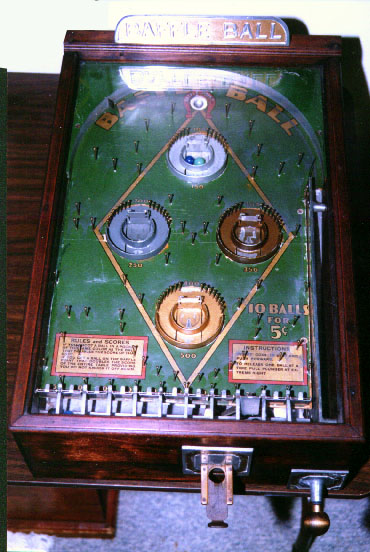
Games similar to this pictured below were first popular in bars and cafes in France and America,
but they were not coin operated - Players first exchanged money for balls to play with, then if
players obtained a high enough score, they would be awarded free drinks, meals and or cigarettes.
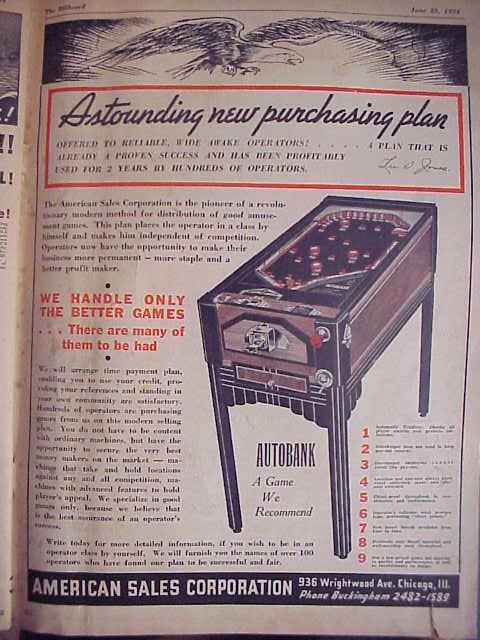
Soon after came the introduction of the first coin-operated Bagatelle and "Bingo" pin tables :
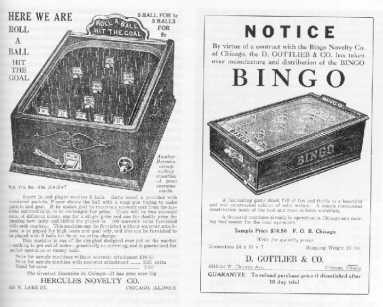
Bagatelle Table Ad Bingo Pinball Ad
Pinball - The Early Years : 1930s - 1940s
The first coin-operated "pinball machine" was invented in 1931 by Automatic Industries and was
called "Whiffle Board". But the gaming industry really began in the mid 1930's with the production
of a game called "Ballyhoo". It was invented by one Raymond Maloney, who later started the Bally
Manufacturing Company of Chicago, IL.
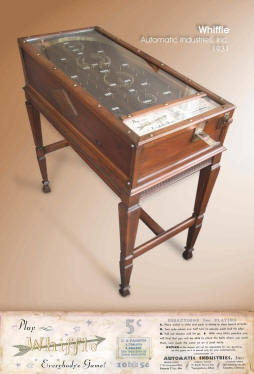 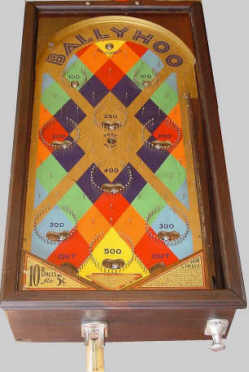
"Whiffle Board", Automatic Ind., circa 1931 "Ballyhoo", Bally Mfg, circa 1934
 Click here for a video of Bagatelle Tables and the Ballyhoo Coin Operated Pin Table Click here for a video of Bagatelle Tables and the Ballyhoo Coin Operated Pin Table
The pinball machines of this era had wooden legs and wooden rails on the sides of the machine,
not like today's modern marvels of chrome and steel.
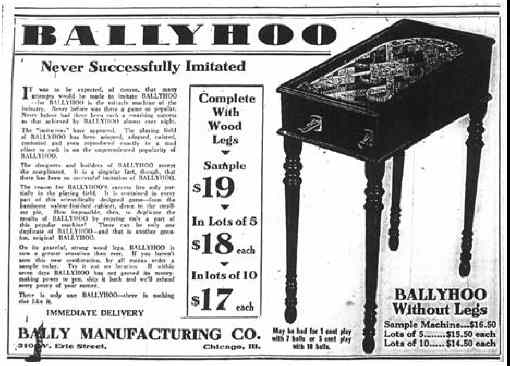
"Ballyhoo" Ad, Circa 1934
It is thought the term "pinball" came into play at this time most likely due to the fact that the all the
machines of this era had many holes and pins in them. In 1933, electricity was first introduced to
pinball by adding a battery to the machine and in 1934, the first automatic scoring mechanism
would appear in the form of a "clock" counter, as well as the first "sounds" in a pinball machine
by way of electromechanical chimes, bells and buzzers. The popularity of the pinball machine
rose dramatically during the mid to late 1930's in part due to the Depression and the need for low
cost entertainment for the masses. Since many pinball operators in the 1930's gave away prizes
based on high scores, some players tried to cheat by shaking and lifting the game, so in 1935, the
"tilt" mechanism (a control that determine how hard a pinball machine can be "shaked") was thought
up by Harry Williams, founder of the famous Williams Manufacturing Company, in response to players
learning how to control the game to their advantage. Modern day pinball machines employ two such
"tilt devices", one that measures the movement of the game side to side, and another called the
"slam tilt" that is used to movement up and down and prevents such acts as "slamming" your
hand into the machine or trying to drop the machine.
The "slam tilt" consists of a couple of "leaf switches" that detect a slam when they touch each other,
while the "movement tilt" uses a pendulum and bob device that freely hangs inside a metal detection
ring. A tilt warning occurs when either the leaf switches meet or if the free-swinging pendulum rod
touches the metal ring. Most modern machines give one to three warnings (user adjustable) before
ending the game. Also in 1935, the first "backglass" appears with lighted scoring. As more features
were added, pinball machines are then outfitted with electrical transformers so they could be plugged
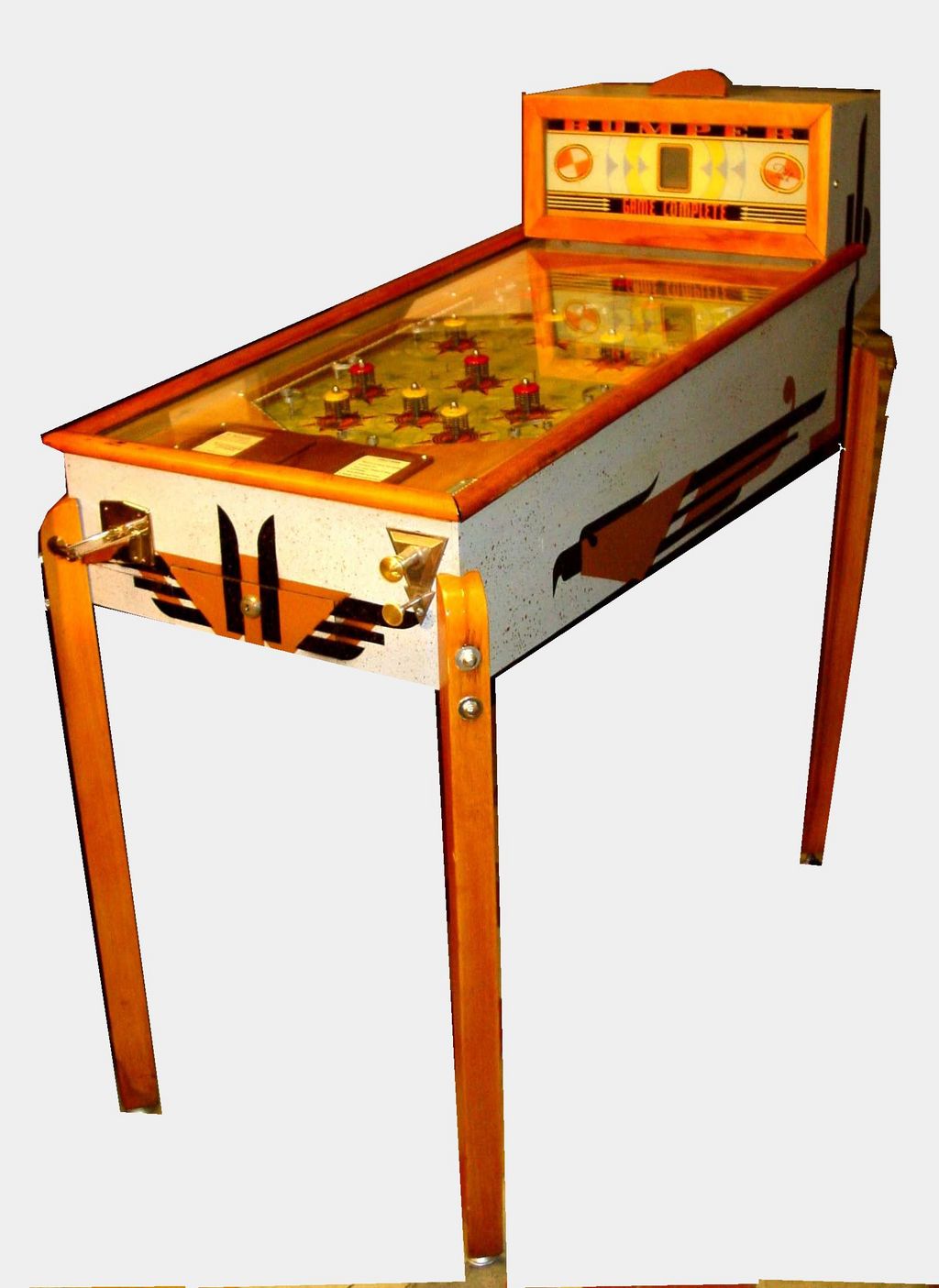
into standard 110V electrical outlets; with that advance, in 1937, the first "coil bumpers" were
introduced on Bally's "Bumper" pinball machine, and in 1939, "disc bumpers" are then introduced.
Also during this time, pinball machine manufacturers grew exponentially - By the early 1930's, over
145 companies were making pinball machines in the USA, with the majority based in Illinois, being
that Chicago was the center of pinball manufacturing at the time. But the competition became fierce,
and the landscape changed dramatically by the mid 1930's, when less than 14 companies remained.
Pinball From The Late 1940's to the 1990's
Pinball machines really grew in popularity after World War II. The ten year period of 1948-58 is referred
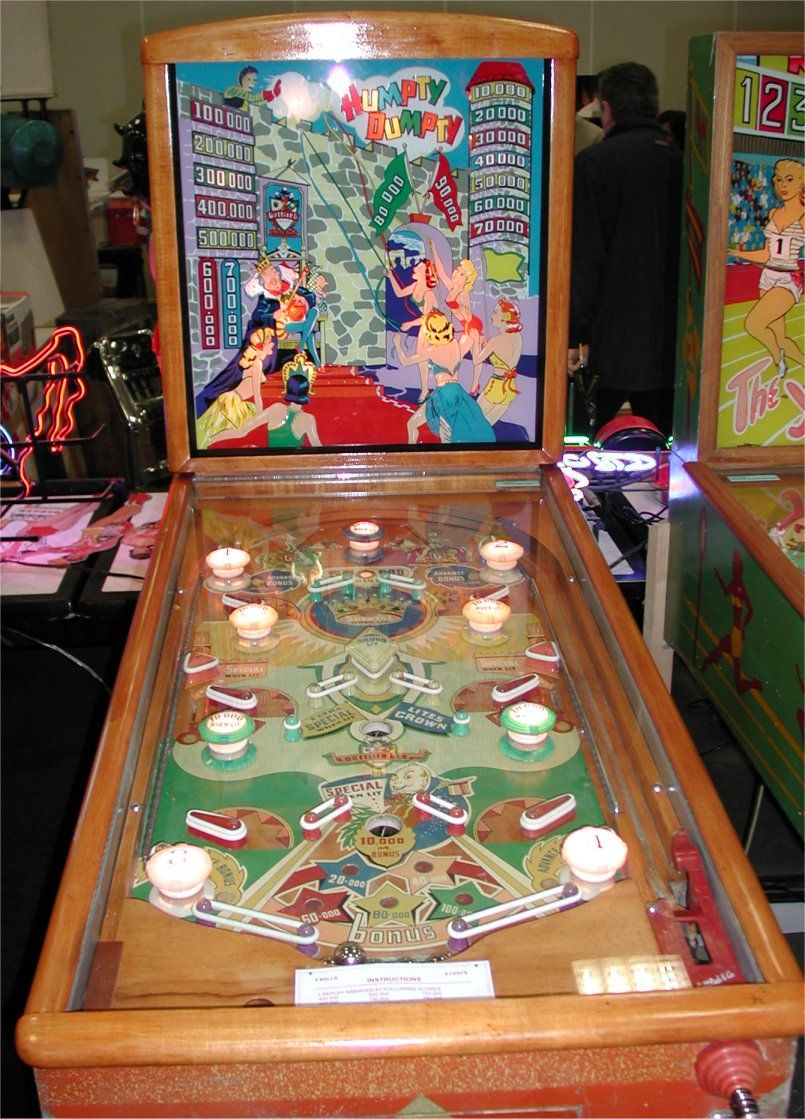
to by some as the "Golden Age" of pinball, due to the invention of flippers in 1947 by the D. Gottlieb Co.
in a game called "Humpty Dumpty", and was one of the main reasons for the renewed interest in
pinball machines at the time. Humpty Dumpty was the very first pinball machine with flippers !
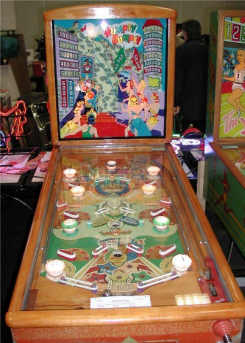 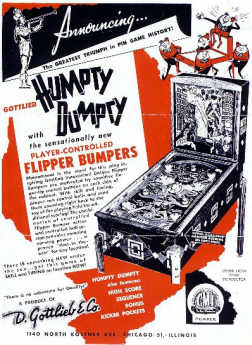
"Humpty Dumpty" Gottlieb, circa 1947 "Humpty Dumpty" Sales Flyer, circa 1947
Click here for a video featuring the Humpty Dumpty Pinball Machine
But also in the mid 1940's, many cities across America started to "outlaw" pinball machines, due to the popular perception that pinball was a game of "chance", not skill (a perception that may have been based
on the older pinball machines not incorporating the use of flippers, which made those machines mostly
a game of chance), and therefore was a form of "gambling" - which of course at the banned across
America at the time, with the exception of the city of Las Vegas. Many lawmakers also thought pinball
was associated with the "mafia" and was dangerous distraction for children.
Also of note during this timeframe, because of effects of fighting World War II, most of America's vast manufacturing capacity was switched over to support the ongoing war effort. And during these war
years (1941-1945), due to materials and part shortages, few pinball machines were ever produced.
But after the war ended, pinball manufacturing started ramping up again; in 1948, a firm called Genco placed one set of flippers at the very bottom of the playfield in a machine called "Triple Action" - But the setup was still a little unusual by today's standards; the flippers were facing outwards, not inwards like today's models. See the picture below:
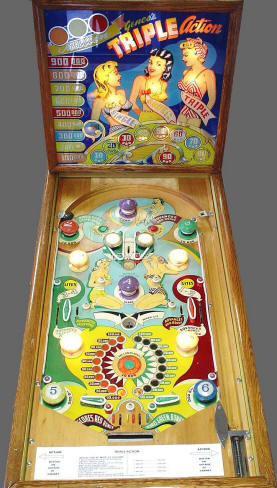
"Triple Action", Genco Mfg., circa 1948
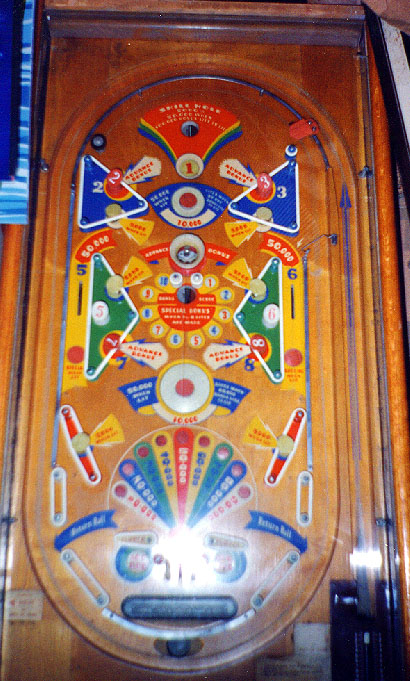
The first game that had a modern flipper arrangement was the "Spot Bowler", a 1950's D. Gottlieb
Co. machine. Take a look at the picture below if you have not seen any of these games - you will
be surprised at the smaller size and position of the flippers - it was not until the mid 70's that most
pinball machines adopted the longer 3 inch flippers we play with on today's modern machines.
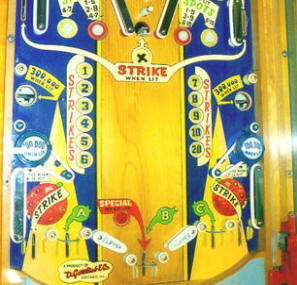 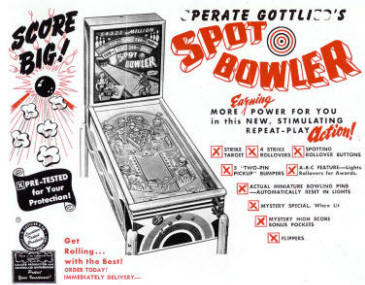
"Spot Bowler" Playfield, D. Gottlieb, circa 1950 "Spot Bowler" Ad, D. Gottlieb, circa 1950
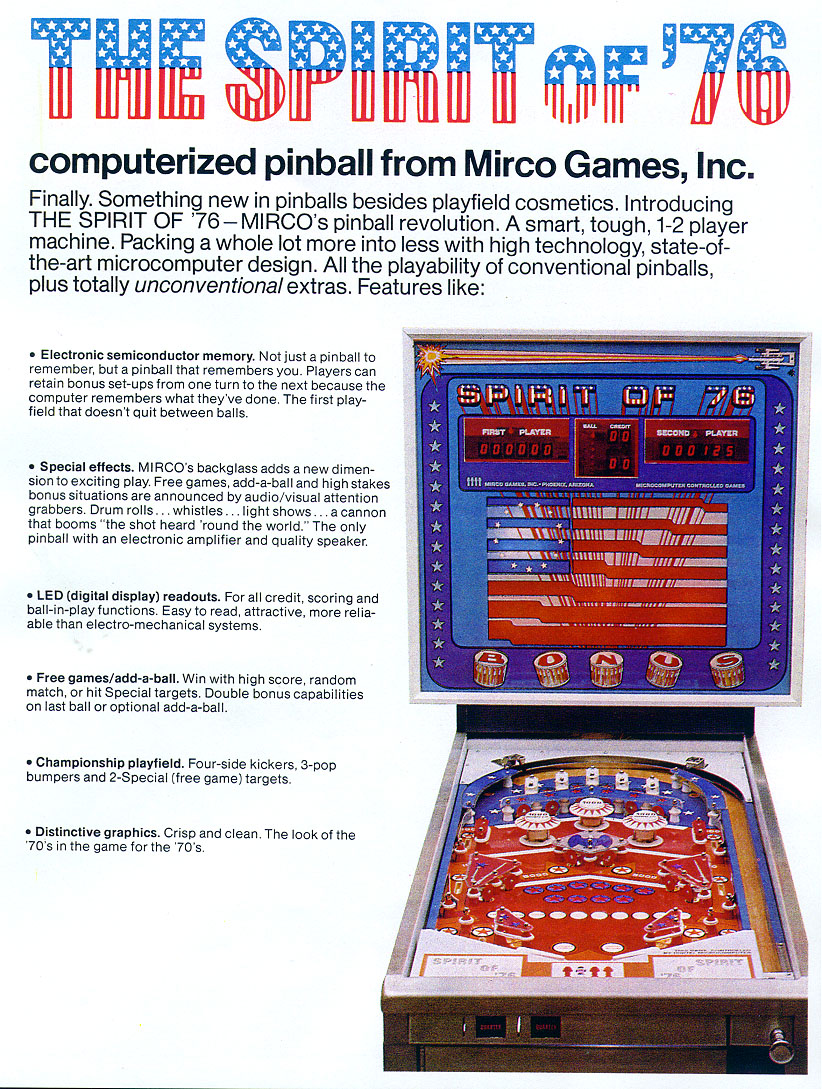
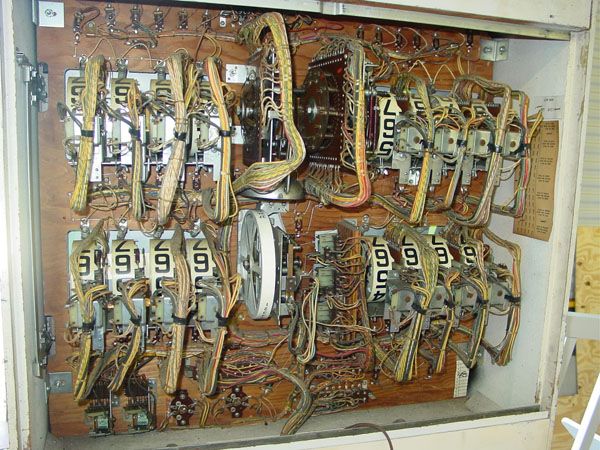
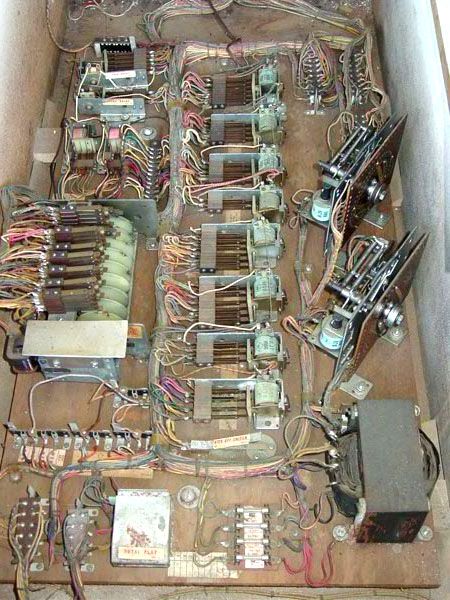
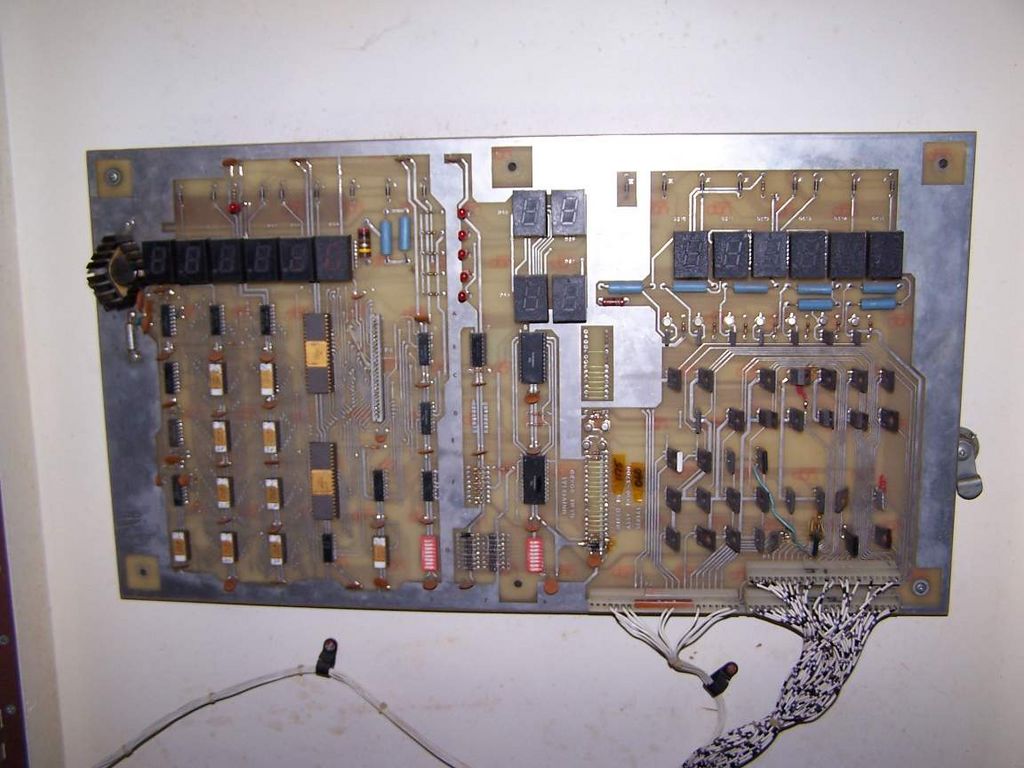
It was also in the mid 70's that solid-state (or electronic) pinball machines were first introduced, starting
yet another huge wave of public popularity due to new games innovations, features, game reliability and
cool design features like electronic scoring, alphanumeric scoring, electronic sounds and finally
electronic speech, which lasted well into the late 80's.
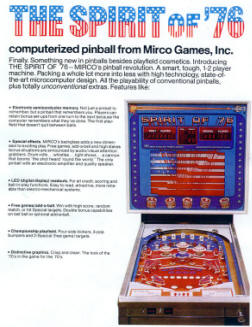 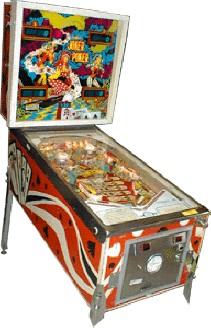
"Spirit Of 76" Ad, Micro Games, circa 1975 "Joker Poker", D. Gottlieb, circa 1978
Click here for a video featuring the Joker Poker Pinball Machine
Finally, in 1976, the New York City "pinball ban" was overturned at a City Council meeting, due in part to
the lobbying efforts of the coin-op amusement industry by proving to the Council that pinball was a really
a game of "skill", and not chance, and therefore should be legalized. They demonstrated their point in a
very unique fashion, by employing the talents of a young magazine editor named Roger Sharpe, who
was of the best players in the area. As the pinball machines lay in front of the council, and surrounded
by hoards of journalists and photographers, Sharpe proceeded to play and told the Council that based
only on his skill, he would get the ball to land through the middle lane on the playfield - And just after completing this historic shot, the City Council then voted to overturn the pinball machine ban for good.
(But as a side note, according to research the city of Nashville recently overturned a long-standing
ban anyone under 18 playing pinball, and it is still illegal to play pinball on Sundays in Ocean City, NJ)
The late 80's saw Williams and Bally merge to become the dominant player in the market, and in the
90's they both produced some of the most amazing pinball machines concepts ever dreamed of like Medieval Madness, Cirqus Voltaire, Twilight Zone, Theatre Of Magic, Monster Bash, Scared Stiff,
Tales Of The Arabian Nights and the most popular pinball machine in modern history, Addams
Family (with over 20,000 produced), along with many other modern-day collectible classics, and
finally the last pinball machines of the golden era of pinball manufacturers, Cactus Canyon and
the "Pinball 2000" machines, which combined video movies over standard pinball action.
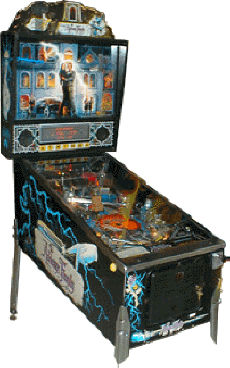 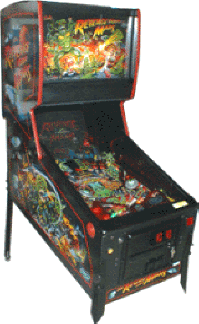 . .
"Addams Family", Bally Mfg., 1992 "Revenge From Mars" (Pinball 2000), Bally Mfg, 1999
Click here for a Bally factory promo video for the Addams Family Pinball Machine
Click here for a video on the development of the Revenge From Mars Pinball Machine
Pinball Today : 2000s to Present
Pinball has come a long way in the last ten years or so, particularly in complexity, rule sets and
game quality. Pinball will continue to advance with the introduction of high-tech devices and
advances incorporated into machine, such as LED's, LCD's, color dot-matrix displays, and
today new color LCD and plasma flat panel monitors replacing the traditional pinball playfield.
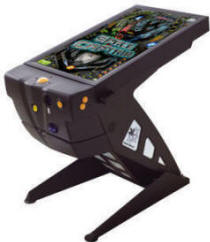 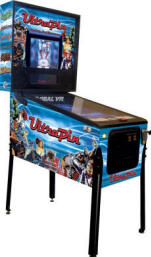
"Virtual Pinball", TAB Austria, 2002 "UltraPin" Digital Pinball, Global VR, 2006
Click here for a video featuring the UltraPin Video Pinball Machine
Pinball has now become a "in" item with high-profile celebrities, baby boomers, business exec's
& families, and has become a fixture on many TV shows and commercials, movie sets and many
magazine shoots, perhaps due to the "nostalgia factor" and the advent of personal home game
rooms, or realization that a individual can now easily purchase a pinball machine, or the fact that
playing a few good games of pinball after a hard day's work can be a tremendous stress-reliever!
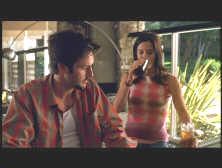
Coke commercial with David Arquette shown
playing one of three classic pinballs in his
actual home collection in the foreground.
By 2002, the industry was left with just one major designer and manufacturer, Stern Pinball, based
in the Chicagoland area and run by Gary Stern, the son of Stern Electronics' founder Sam Stern.
Stern has released quite a few interesting and collectable titles over the past few years, and
hopefully will continue on in the tradition of great firms like Williams and Bally on future releases.
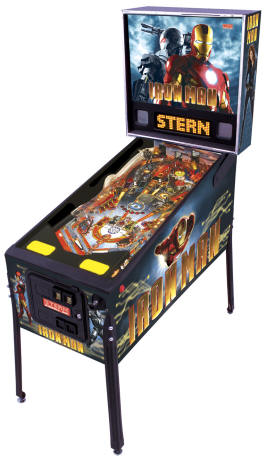
"Iron Man", Stern Pinball, circa 2010
Click here for a video featuring "Iron Man" Pinball Machine
Stern Pinball's ratio of "home sales" to commercial sales has risen from practically zero to an estimated 35% - 60% of their total sales in just the last 3 years, which is an encouraging new market for them to
sell into in the coming years as operator and commercial account orders continue to dwindle. There
have been some rumblings of other firms within the coin-op industry having aspirations of jumping into
the pinball machine game, but nothing seriously has been reported or announced to date. It will be very interesting to see what the future holds for pinball over the course of the next century... However, in late 2008, Stern announced, for the first time in its history, a major layoff of many in-house pinball designers, engineers and technical staff, due to declining sales because of the current economic climate, which questions the future of Stern Pinball, and new pinball machines in doubt - So it you want to purchase
a new pinball machine, buy one as soon as possible, because we predict that if Stern actually goes
out of business, the price of all remaining pinball machines will skyrocket after the economy improves.
As for the state of used or "pre-owned" machines, supplies are very tight and getting tighter, with ASP (average selling price) of good quality of pre-owned pinball machine of popular titles from the late 80's
to 90's now appreciating at a rate of 10% - 25 % or more per year, even in this economic climate, as
more and more individuals discover (or re-discover) the pleasures of pinball ownership and supplies
dry up. Just a few years ago, America had all the machines it ever needed to meet domestic supply;
but now it is estimated that over 70% of all preowned pinball machines now sold in the US come
from overseas sources in countries such as Western Europe and Latin America, due to the
increasingly high demand from Americans, even now in this depression-like economic climate.
But from 2013-2020, new pinball developers starting to enter into the pinball machine industry
and challenge the "old guard" makers like Stern Pinball with new and very exciting innovations, from embedded LCD Monitors and Backboards to multi-colored LED playfield lighting, and one of the most promising new players to hit the scene is Jersey Jack Pinball, with the introduction of their radically designed "new-age" pinball machine called "Wizard Of Oz" in 2013.
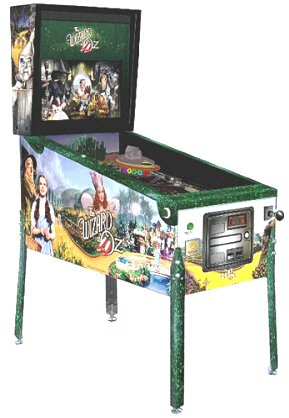
"Wizard Of Oz - Emerald City Edition", Jersey Jack Pinball, 2013
Click here for a video featuring the "Wizard Of Oz" Pinball Machine
Surprising Pinball Machine Fact :
Did you know that it was illegal to own a pinball machine in New York and in many other states
at one point in time? Pinball machines were officially banned in New York in 1942 until the late 1970's,
because the city administration viewed the game as a "game of luck" rather than a "game of skill"...
Mayor La Guardia was quoted before the ban saying he believed the machines "robbed the pockets
of schoolchildren in the form of nickels and dimes given them as lunch money". Given his statement,
it came as no shock when a pinball machine "ban" was carried out in dramatic fashion in New York -
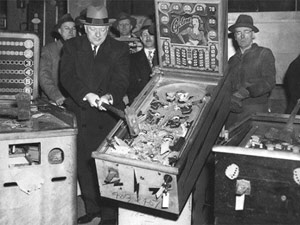
In 1942, Mayor Fiorello La Guardia started executing a massive prohibition-style raid across the city by issuing
an ultimatum to the NYPD that their "top priority" would
be to round up all the pinball machines in the city and arrest their owners - The raid resulted in thousands
of machines being confisticate, then smashed with sledgehammers by the Mayor and the NYPD before
being dramatically dumped into the city's rivers. But
pinball in New York City did not disappear - it simply moved to low-key locations in "sketchy" areas..
From the Las Vegas Mercury Newspaper, Thursday, March 28, 2002 -
"In their earliest incarnations, some pin games (so named for the pins that dotted the playfield, guiding
the ball into holes with point values) such as Bally's 1933 Rocket offered cash payouts to the player if
he landed the ball in certain holes. It wasn't unusual to see such games taking their place next to conventional slot machines.
The advent of payout machines, versus nonpaying "novelty" machines manufactured by many of the
same companies, raised some sticky questions about this new form of entertainment: Was pinball a
game of skill or luck? The answer would mean the difference between a harmless game and a form of gambling- even if the "payout" was a free game.
Some states decided the latter and banned pinball machines. In January 1942, for instance, New York Mayor Fiorello Henry LaGuardia banned pinball as a form of gambling, smashing several machines
in a publicity stunt.
Also, the passage of the Johnson Act in 1950 outlawed interstate shipping of certain types of pinball machines, as they were deemed gambling devices. Pinball manufacturers such as Williams and
Gottlieb responded by mounting a campaign of their own under the aegis of the Coin Machine Institute; these pinball makers eliminated payout machines and sought to show that pinball was a wholesome pastime that had no connection to gambling--especially with the advent of flippers in 1947, which
turned pinball, more than ever, into a game of skill.
Still, the ban in New York lasted until 1976; free games in the form of awarded replays are still illegal
in New York and in other cities, though the laws are rarely enforced."
Modern Pinball History Timeline
1931 -
The first commercially successful pinball machine, "Baffle Ball" is introduced by Gottlieb.
1933 - The first mechanical "tilt" mechanism is introduced by Gottlieb in "Broker's Tip", and the
very first electrical tilt mechanism is introduced by ABT Manufacturing in "Autocount".
1936 - The first "bumpers" in a pinball machine are introduced by Bally in "Bumper".
1947 - The first pinball machine to to use ball "flippers" is seen in "Humpty Dumpty" by Gottlieb.
1948 - The first use of "active" or rebounding bumpers is introduced by Williams in "Rainbow".
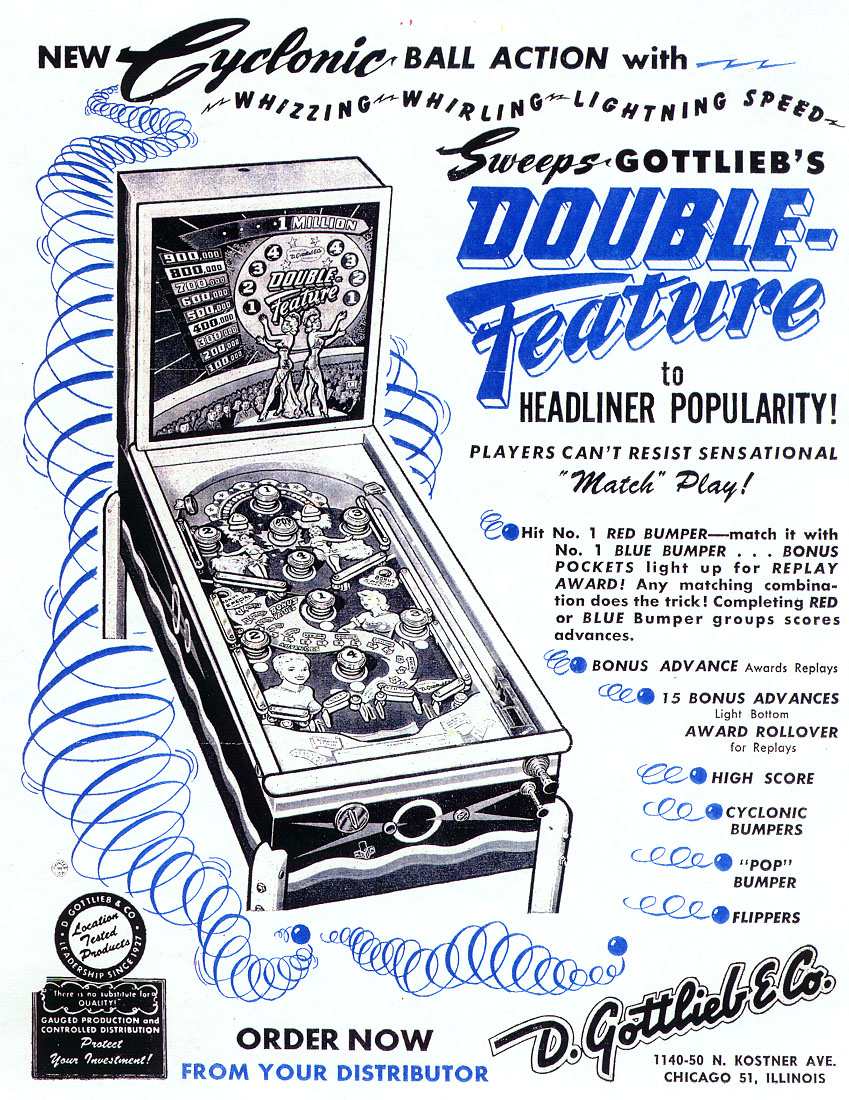
1951 - The first playfield "slingshot" kickers (mostly triangular shaped in modern games) were
introduced with the "Double Feature" pinball machine made by Gottlieb
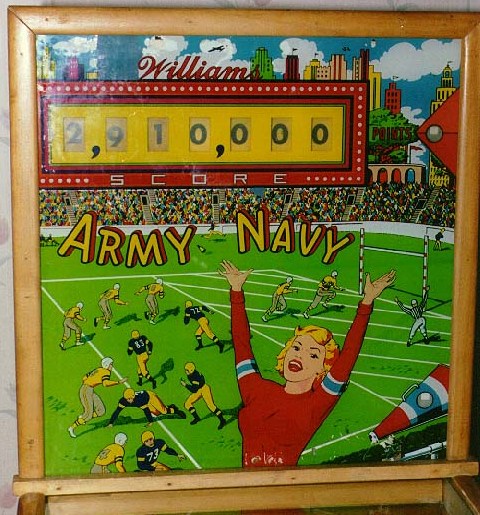
1953 - The first two-player pinball machine is released. (pinball machines before this were
strictly one player affairs) and the first use of "score wheels" ("Army Navy" - Williams)
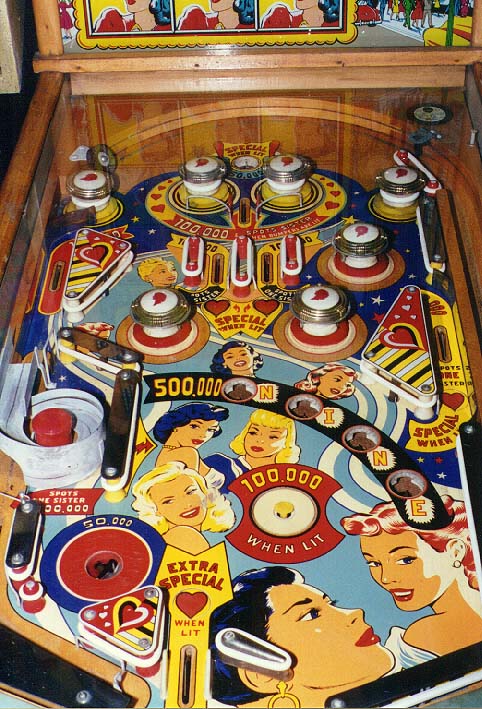
and also the first use of "ramps" on playfields ("Nine Sisters" from Williams Mfg.)
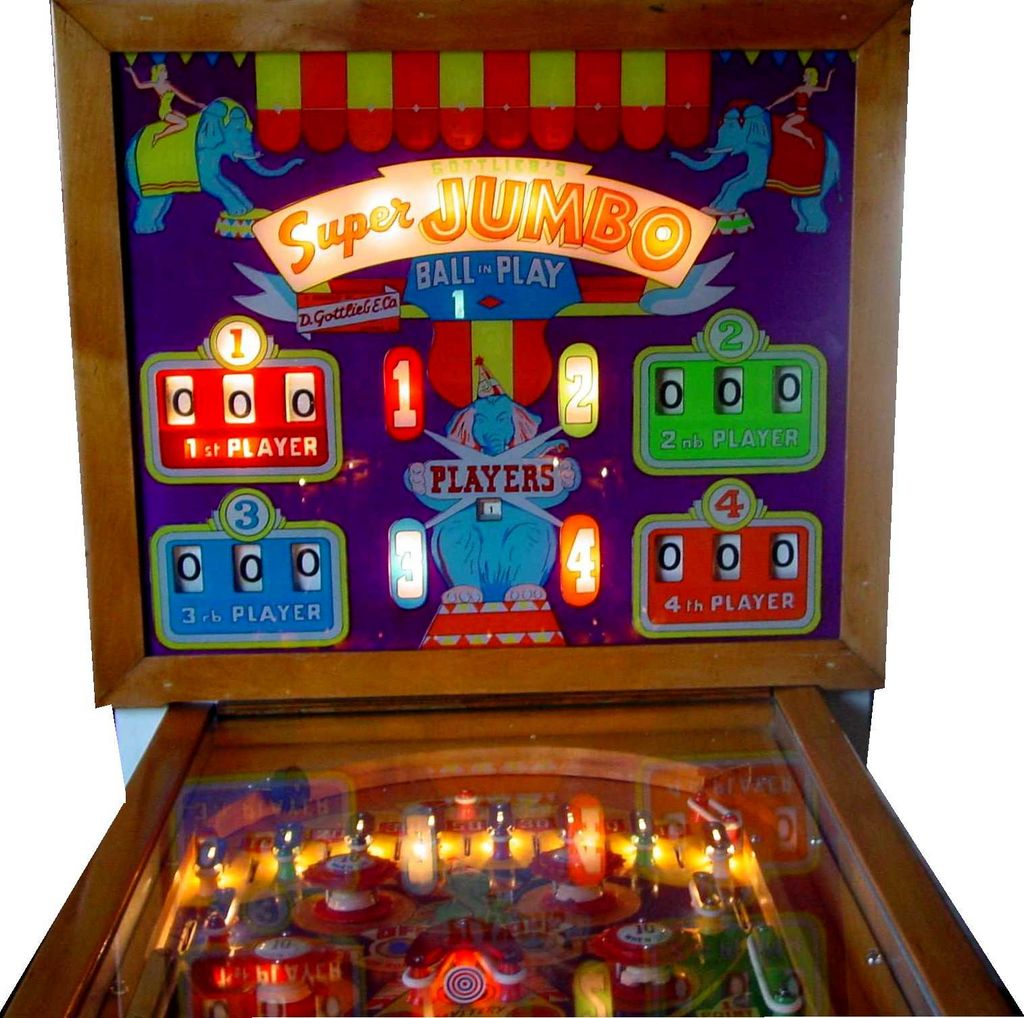
1954 - The first multiple player pinball machine, "Super Jumbo", is released by D. Gottlieb.
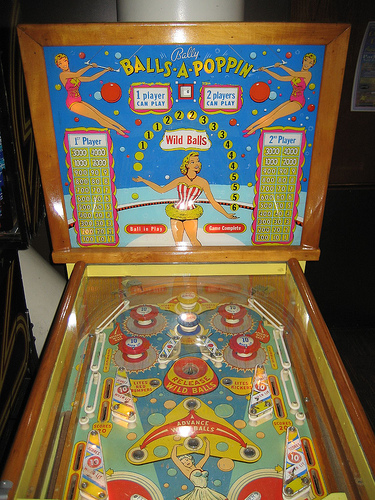
1956 - The first "multiball" feature is featured on Bally's "Balls-A-Poppin" pinball machine.
1957 - The first use of a "match" bonus feature (a number in your final score is matched at
random to a number the machine picks, resulting in a free game, or "credit") in
pinball is introduced.
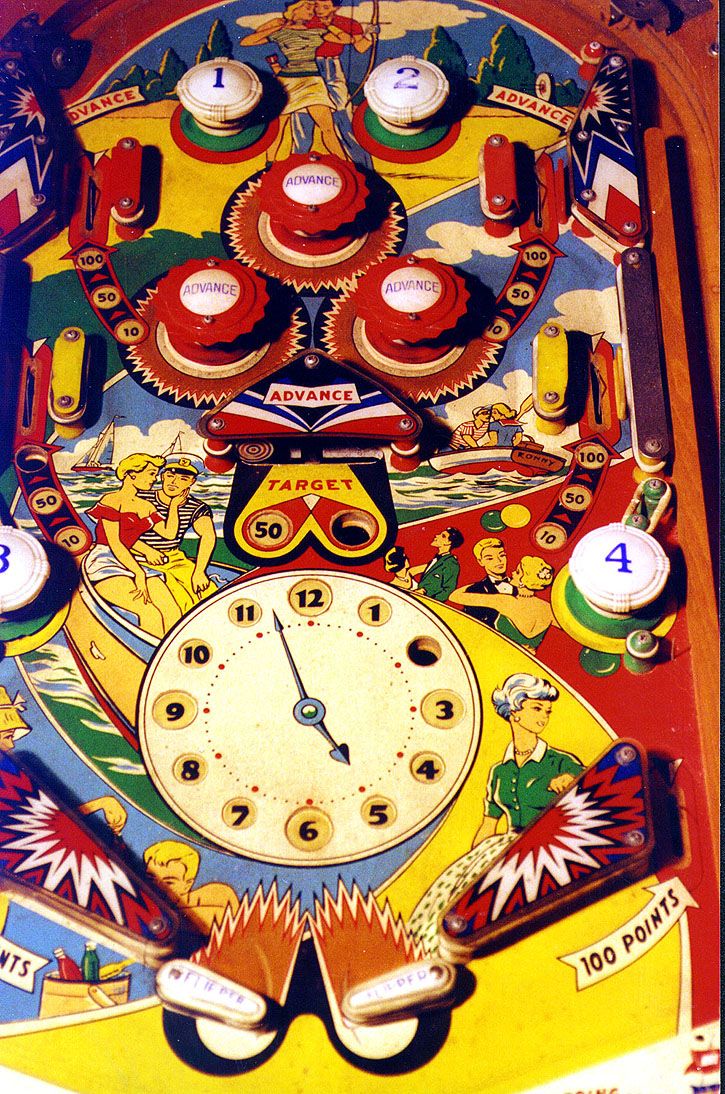
1960 - The first moving target in pinball is introduced with the "Magic Clock" from Williams.
The first "add-a-ball" (extra ball) game called "Flipper" is developed by D. Gottlieb.
The add-a-ball award was developed to counter various laws in effect during this
period that made it illegal for a game to award replays in certain parts of the country
because it was consider a "gambling" activity, especially in New York City
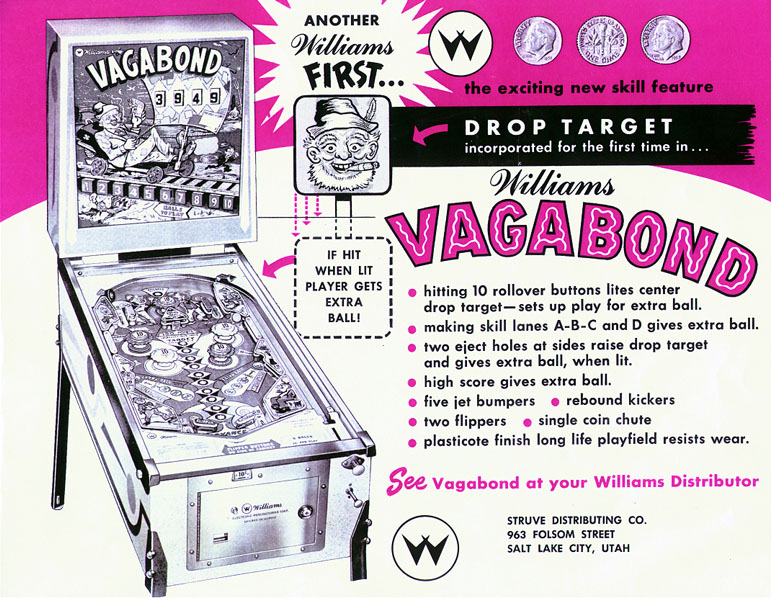
1962 - The first "drop targets" were introduced by Williams Manufacturing in "Vagabond".
1963 - The first "spinners" on a pinball playfield are introduced.
1964 - The first "mushroom" bumper (common in all of today's modern games) was
introduced by Bally.
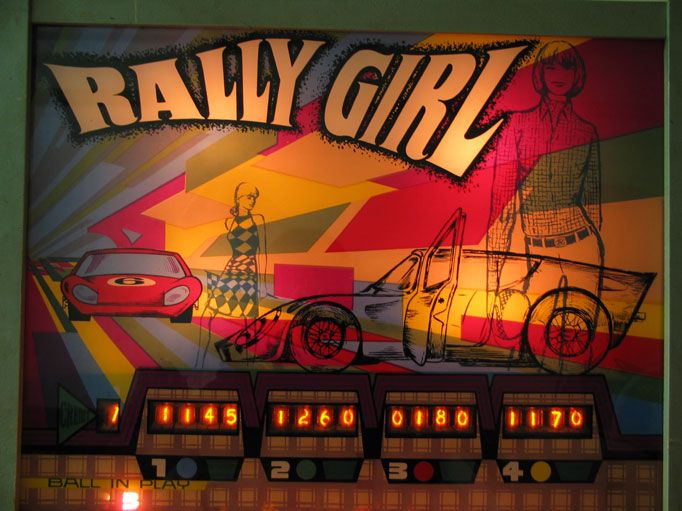
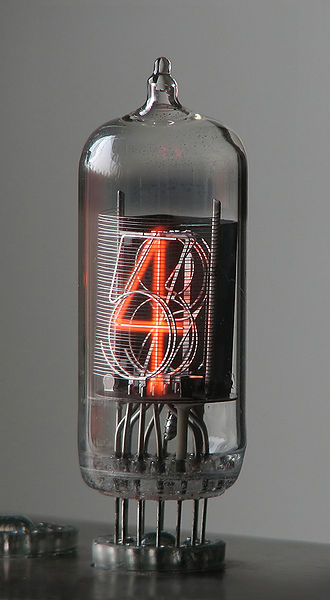
1966 - The first digital scoring pinball machine, "Rally Girl" is produced by a French
company called Rally, using "Nixie Tube" (cold-cathode) glowing display tubes.
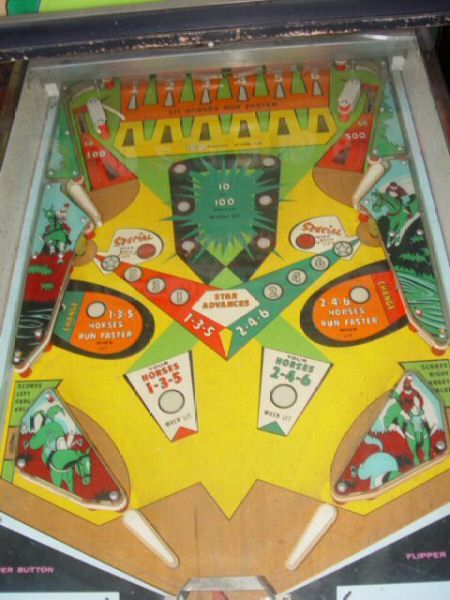
1968 - The first modern flippers (3 inches) are introduced on "Hayburners II" by Williams.
1975 - The first solid-state, or electronic pinball machine, "Spirit of 76", was first introduced
by Micro Games. It marks the beginning of the switch from electromechanical (EM)
machines to electronic (or "solid-state") pinball machines. And the first pinball
to be based on a licensed movie "theme", "Wizard!", is introduced by Bally.
The Magnificent Marble Machine, the largest non-commercial pinball machine ever
made (20' high x 12' long) was introduced on a NBC TV show of the same name.
Click here for a video featuring the Magnificent Marble Machine
1976 - The first widely available "solid state" pinball machine was introduced by Bally and
is called "Freedom". Many of the games from the mid 70's were produced in two
separate versions (both electronic and electromechanical), including Freedom.
Click here for a video featuring the Freedom Pinball Machine
The first "wide-body" pinball, "The Atarians" is introduced by Atari. Also in this year,
the long-time pinball machine manufacturer Chicago Coin makes its very last game,
and Chicago Coin is taken over by Sam Stern (father of Gary Stern), and renamed
"Stern Electronics" (now Stern Pinball). Also, Gottlieb is sold to Colombia Pictures.
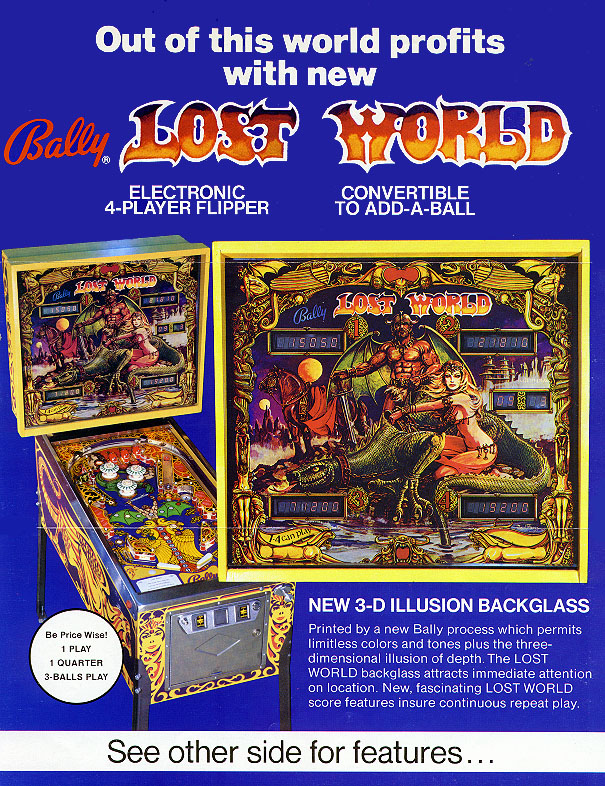
1977 - The first electronically produced sounds in a pinball machine were introduced, and the
first photographic / "3D" backglass display is introduced by Bally on "Lost World".
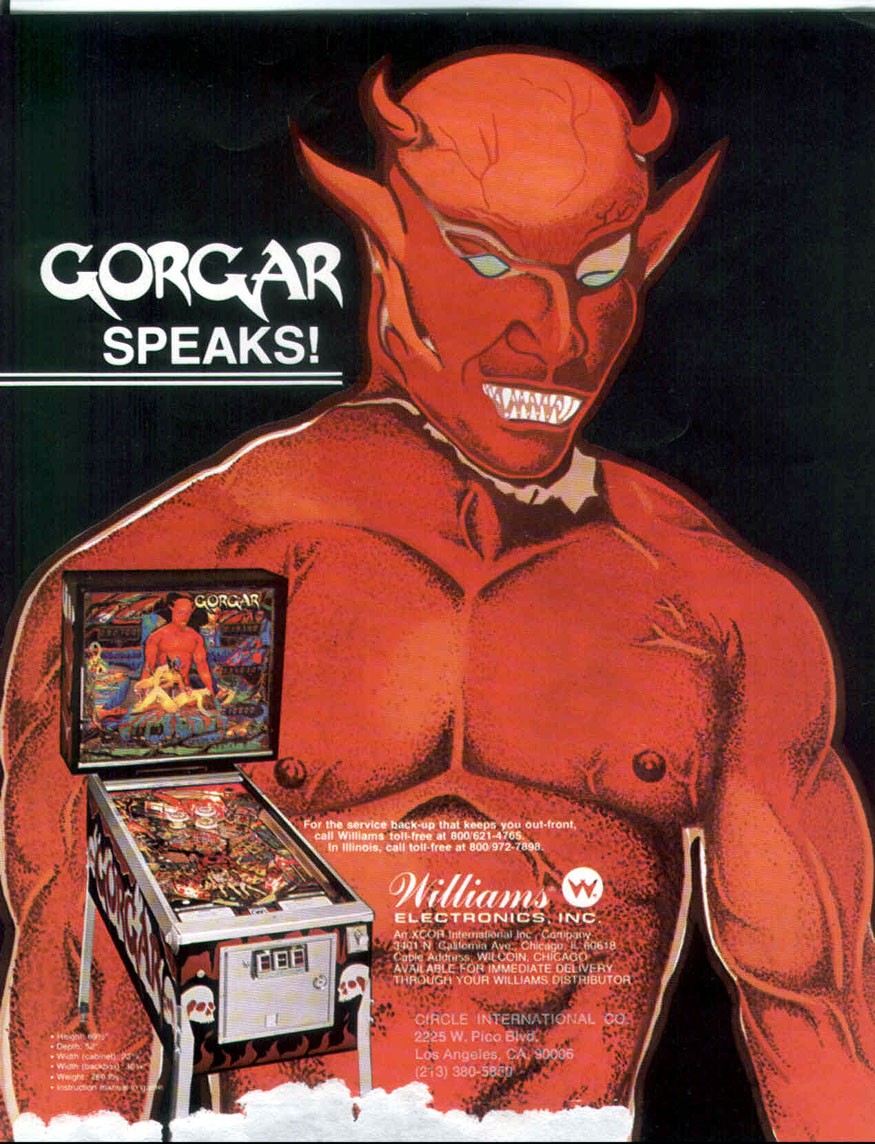
1979 - The first "talking" or electronic speech game, which included 7 words, was introduced
by Williams and was called "Gorgar", along with the first pinball machines to have a
continuous electronic background "soundtracks". This was also the year in which the
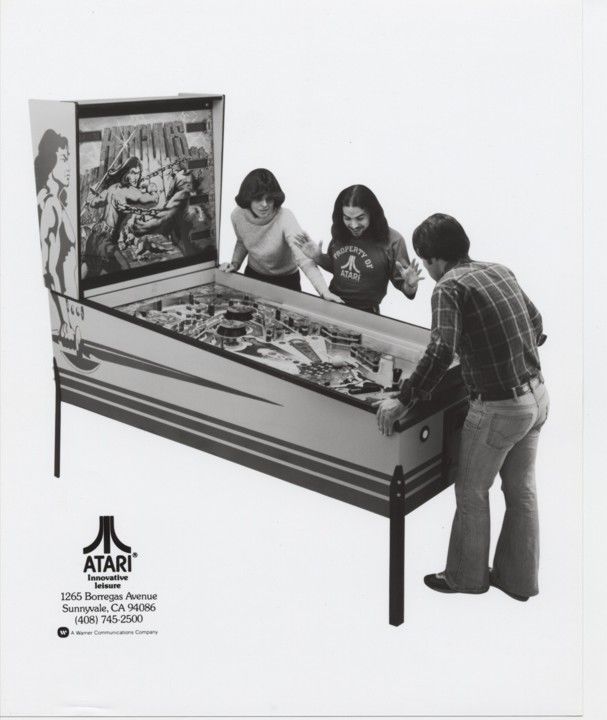
very last electro-mechanical (EM) pinball machine was made by Gottlieb. And finally,
the largest commercially-produced pinball machine, "Hercules" is introduced by Atari
Click here for a Williams factory promo video of "Gorgar" Pinball Machine speech
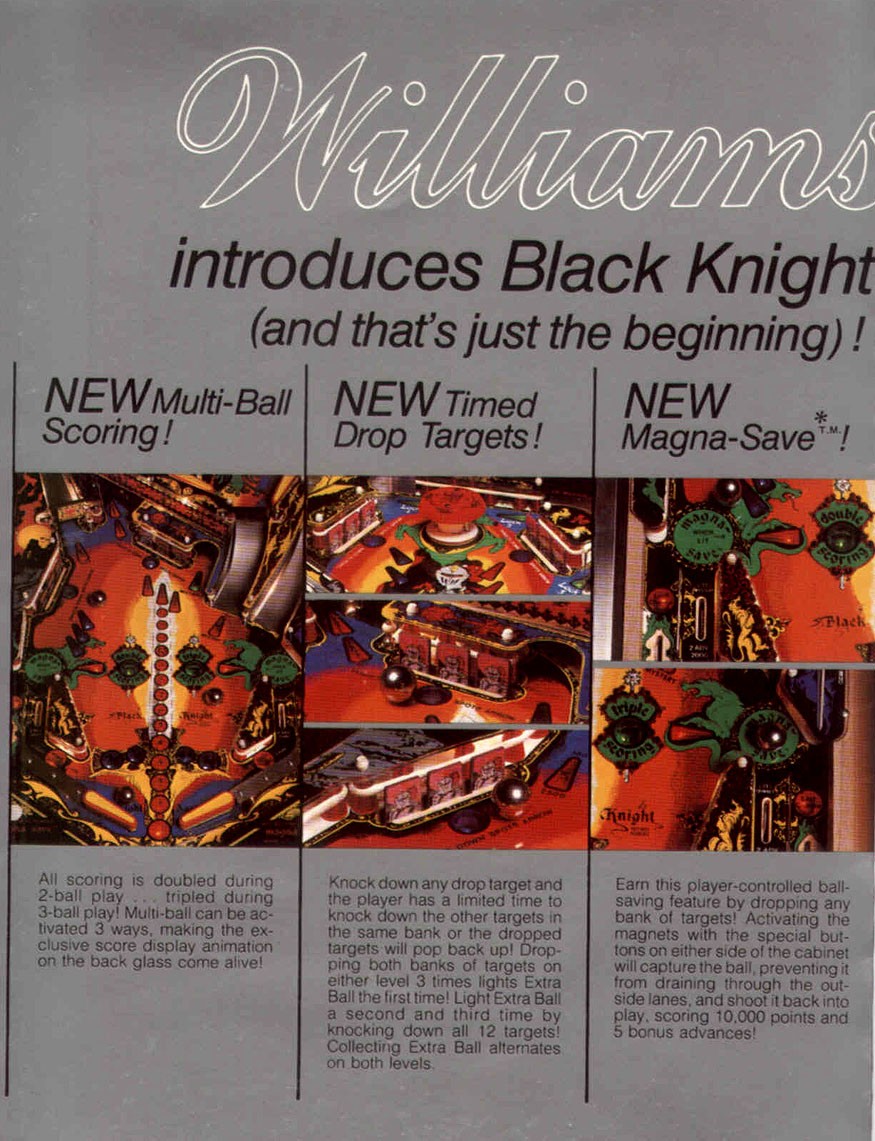
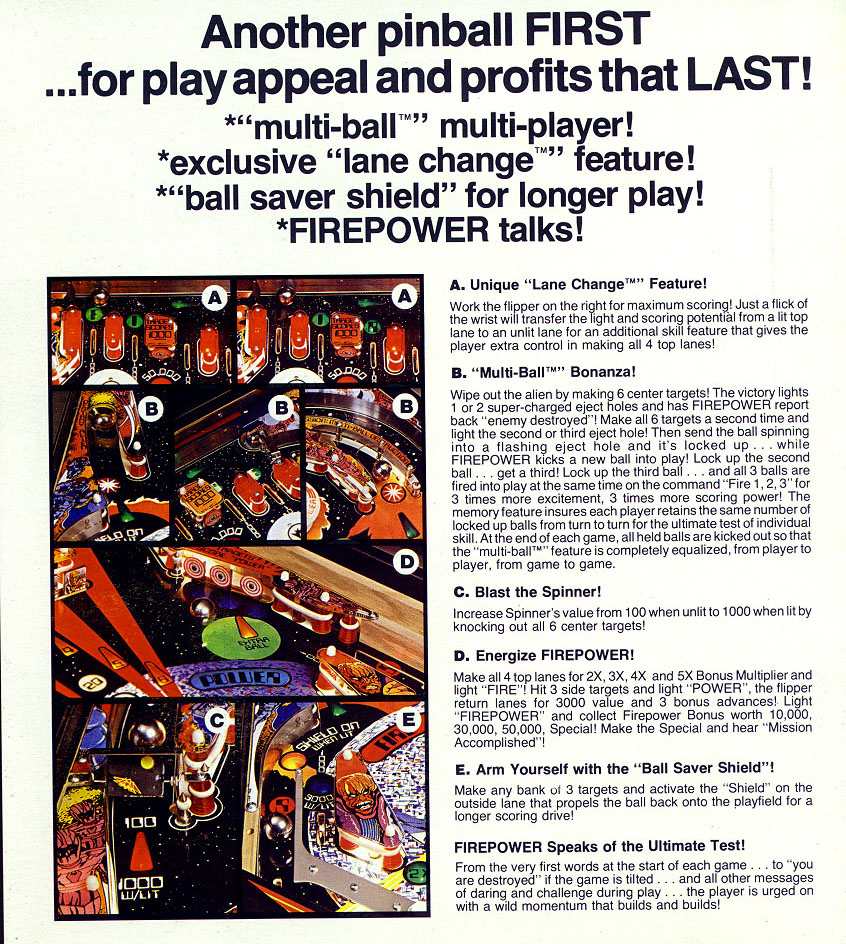
1980 - The first "multi-level" pinball machine, along with the first "magna-save" player-controlled
ball magnet feature is introduced by Williams in "Black Knight", along with the first "lane
advance" feature introduced in "Firepower", also by Williams Manufacturing.
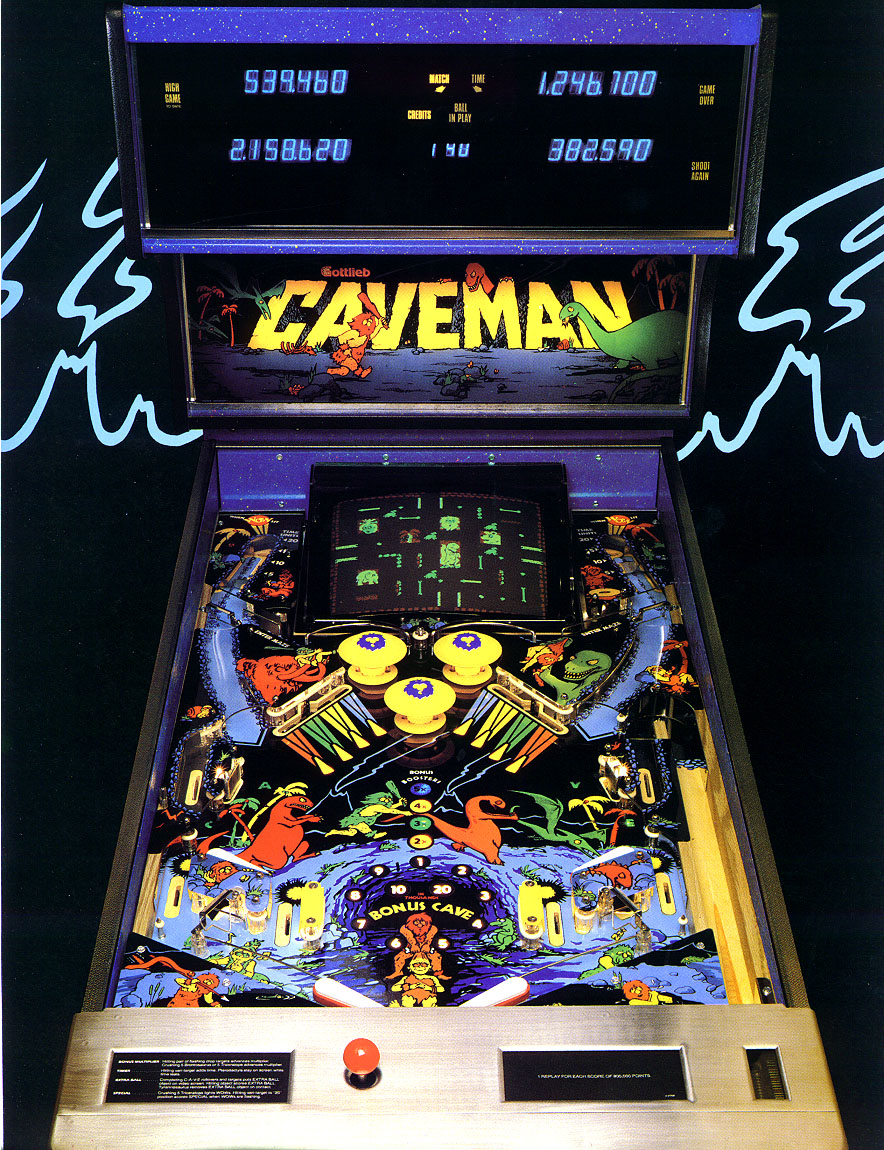
1982 - The first combination of a mechanical pinball machine with a video arcade game is
introduced in a hybrid pinball machine game called "Caveman" by Gottlieb.
Click here for a video featuring the Caveman Video Game / Pinball Machine
1984 - Colombia Pictures, owner of D. Gottlieb, decides to close the firm. The company is
then taken over by Premier Technology, but the Gottlieb name remains alive.
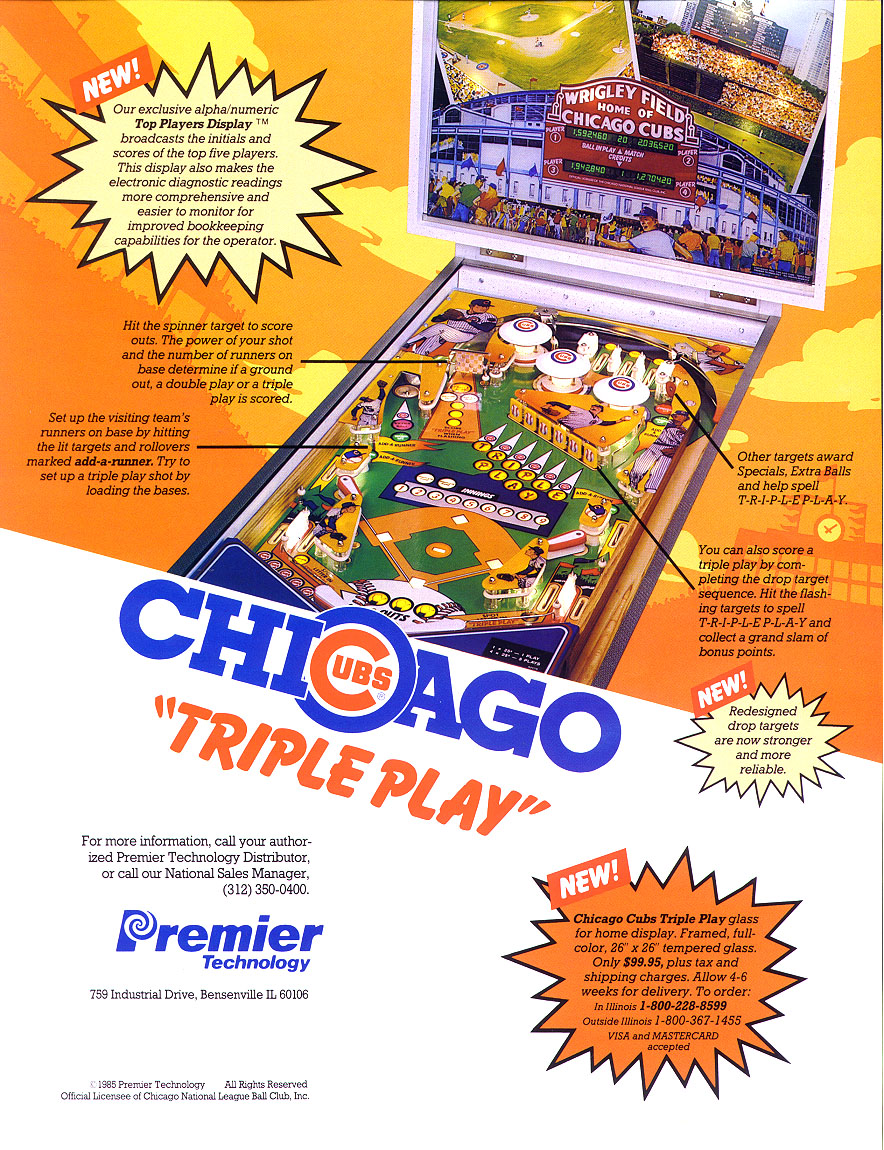
1985 - The first "alphanumeric" digital pinball machine scoring display is introduced by
Gottlieb in the "Chicago Cubs Triple Play" pinball machine
1986 - The first automatic replay percentage feature, along with the first use of a commercial
soundtrack and songs, and the first "jackpot" to carryover between games is introduced
in "High Speed" by Williams. Also, the first pinball machine to use an actual photograph
duplicated on the pinball backglass is introduced with "Raven" by Premier Technology
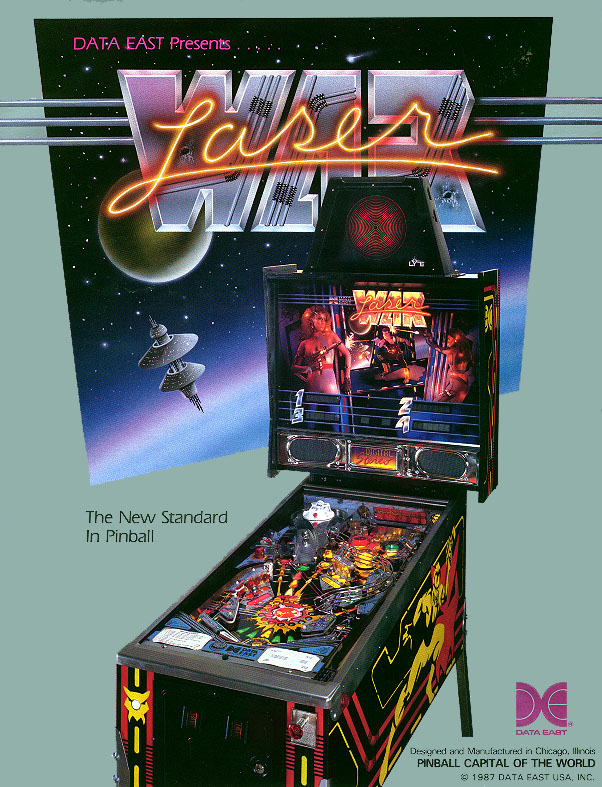
1987 - The first pinball machine with digital stereo sound ("Laser War") is introduced by Data-
East, and the first automatic ball-save feature is seen in "F-14 Tomcat" by Williams.
1988 - Bally Manufacturing is taken over by Williams Electronics, but the two companies
continue to produce separate lines of pinball machines under both names.
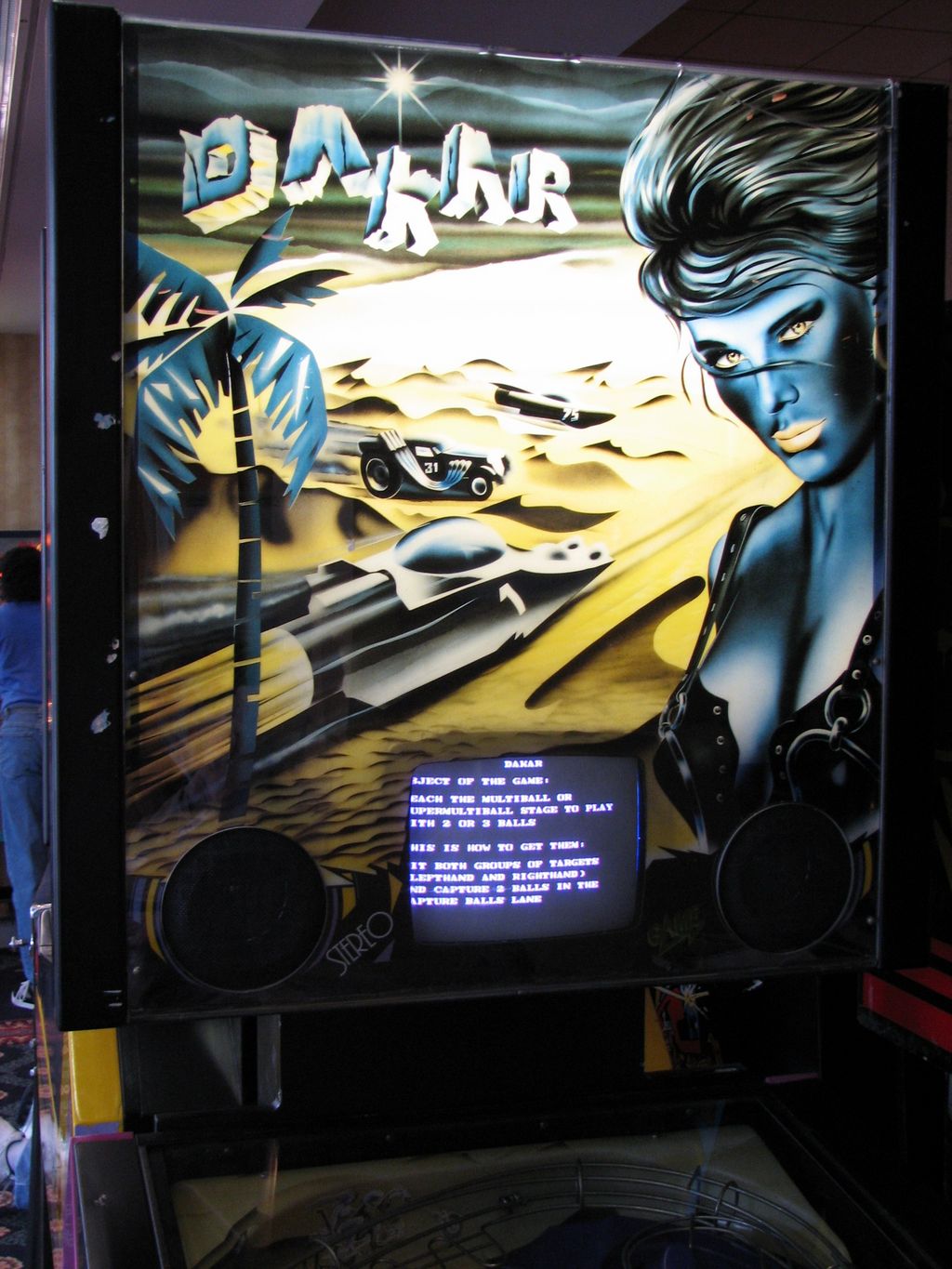
Also in this year, the first pinball machine with a video scoring display monitor is seen
in the "Dakar" pinball machine made by Mr. Game, a firm based in Bologna, Italy.
1989 - The first "wizard" (or expert) mode is introduced in "Black Knight 2000" by Williams
1990 - The first solid-state (electronic) flippers are introduced by Data-East.
1991 - The first "dot-matrix" scoring display is introduced by Data-East in "Checkpoint"
along with video "modes" that animate certain parts of the game part on screen.
Also in the year, electronic plungers become common and the "ball-saver" feature
is introduced, in part due to laws in the UK (England) governing games of chance.
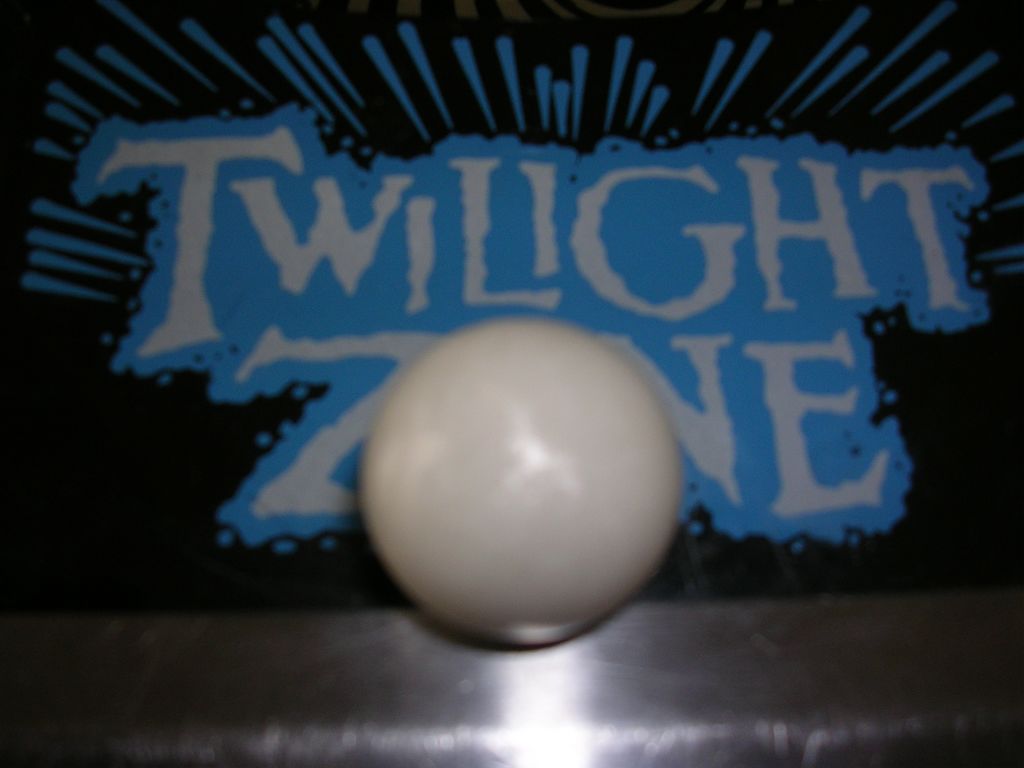
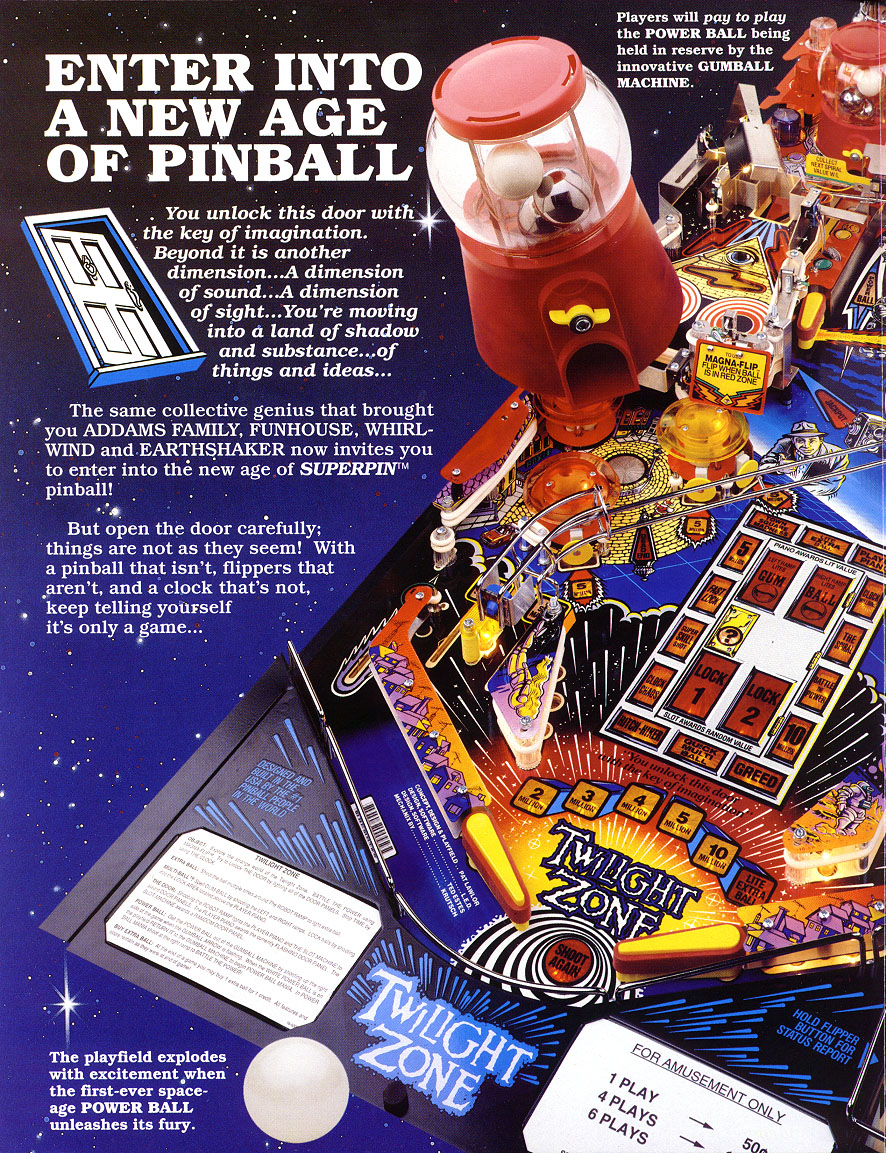
1993 - The first use of a ceramic, or non-magnetic pinball, called the "Powerball" is first
introduced in the "Twilight Zone" pinball machine from Bally Manufacturing. Also
in this year, the first player-controlled "mini playfield" is seen in "Indiana Jones".
1994 - Sega buys out Data-East and is renamed "Sega Pinball".
1996 - Gottlieb (Premier Technology) goes out of business for good.
1998 - The first pinball machine with a video screen integrated into the playfield design
is introduced by Williams in their new "Pinball 2000" series pinball machines.
Click here for a video featuring the Revenge From Mars Pinball 2000 Machine
1999 - After just two Pinball 2000 releases, Williams Manufacturing (WMS) exits the pinball
machine business for good, but continues on as a maker of gaming devices for the
global gambling industry. Also in this year, Gary Stern buys Sega Pinball, renames
the combined firms as Stern Pinball and continues on as the only large scale
commercial pinball producer in the world in for most of the new decade.
2002 - A prototype of the first truly digital pinball machine, "Virtual Pinball" is introduced
at the 2002 IAAPA Amusement Show in Orlando by TAB Austria, and comes with a
a flat panel monitor replicating the playfield and housed in a non-standard cabinet.
2006 - The first digital video pinball machine that replicates the look, play and feel of a
traditional pinball machine on a flat screen monitor that replaces the traditional
playfield called "UltraPin", is introduced by UltraCade (GlobalVR), and features
12 digitally re-created classic pinball machine playfields from Funhouse, Eight Ball,
Pin-Bot, Medieval Madness, Black Knight 2000, Attack from Mars, F-14 Tomcat,
Fathom, Firepower, Strikes and Spares, Sorcerer and Xenon, all in one unit.
Click here for a video featuring the UltraPin Video Pinball Machine
2013 - The first "new age" pinball machine that replaces the static "backboard" or marquee
of a pinball machine with a LCD Monitor and also introduced full, multi-colored LED
lighting throughout the entire playfield along with other innovative pinball machine
enchantments is introduced by Jersey Jack Pinball, and called the "Wizard Of Oz".
Click here for a video featuring the "Wizard Of Oz" Pinball Machine
Acknowledgments to the Internet Pinball Database and The Coca-Cola Company for some picture content in this article
|